
NYLS’s Constitution and Citizenship Day Summit: Exploring Civic Engagement and Education
On September 16, 2025, New York Law School (NYLS) hosted the inaugural Constitution and Citizenship Day Summit in collaboration with our Center for New York City and State Law and The Honorable Robert A. Katzmann Justice for All: Courts and the Community Initiative. Timed to honor Constitution and Citizenship Day on September 17, the Summit brought together judges, attorneys, educators, students, and civic leaders to examine the rule of law and ways to revitalize civics education. The day’s programs were thoughtfully designed to follow four key thematic pillars: Civic Engagement and Democratic Participation, Civics Education, Legal Institutions and the Civic Mission, and Technology and Information Integrity.
The Summit welcomed over 550 participants and was designed and facilitated by a dedicated Planning Committee of NYLS community members and civic leaders from across New York and beyond. The Planning Committee was co-chaired by NYLS Dean and President Anthony W. Crowell, who also serves as Faculty Director of the Center for New York City and State Law, and Hon. Joseph Bianco of the U.S. Court of Appeals for the Second Circuit and Hon. Victor Marrero of the U.S. District Court, Southern District of New York, the Co-Chairs of the Justice For All initiative. Learn more about the Summit’s Planning Committee, speakers, programming, and resources.
Opening Session
The Summit opened with a conversation featuring U.S. Supreme Court Justice Sonia Sotomayor, joined by Judge Bianco, Judge Marrero, and Judge Anthony Cannataro ’96 of the New York State Court of Appeals, who is also a NYLS Distinguished Adjunct Professor. Moderated by Dean Crowell, the discussion emphasized civics education as an essential tool for teaching and upholding the rule of law, protecting democracy, and inspiring broad civic engagement, while also underscoring the role of law schools in this work.
Present in spirit was the late Hon. Robert A. Katzmann, Former Chief Judge of the U.S. Court of Appeals for the Second Circuit. Chief Judge Katzmann launched the Justice for All Initiative in 2014, eager in his mission to expand civics education and increase public understanding of the judiciary’s role in civic life. His mission continues through the work of Judges Marrero and Bianco and his friend and former colleague, Justice Sotomayor. The conversation set the tone for the day, honoring Chief Judge Katzmann’s legacy while broadening the scope of civic participation.
Speaking about the critical significance of civic literacy, Justice Sotomayor stated, “If you are permitting or asking for laws to be changed without fully understanding the consequences of that choice and what the cost is, we’re going to live in a world where people will have laws run over them because they’re not looking at oncoming traffic. Literacy and media are critical for us to live in a democracy. Without it, we are not only affecting our own lives, but the lives of so many others.”
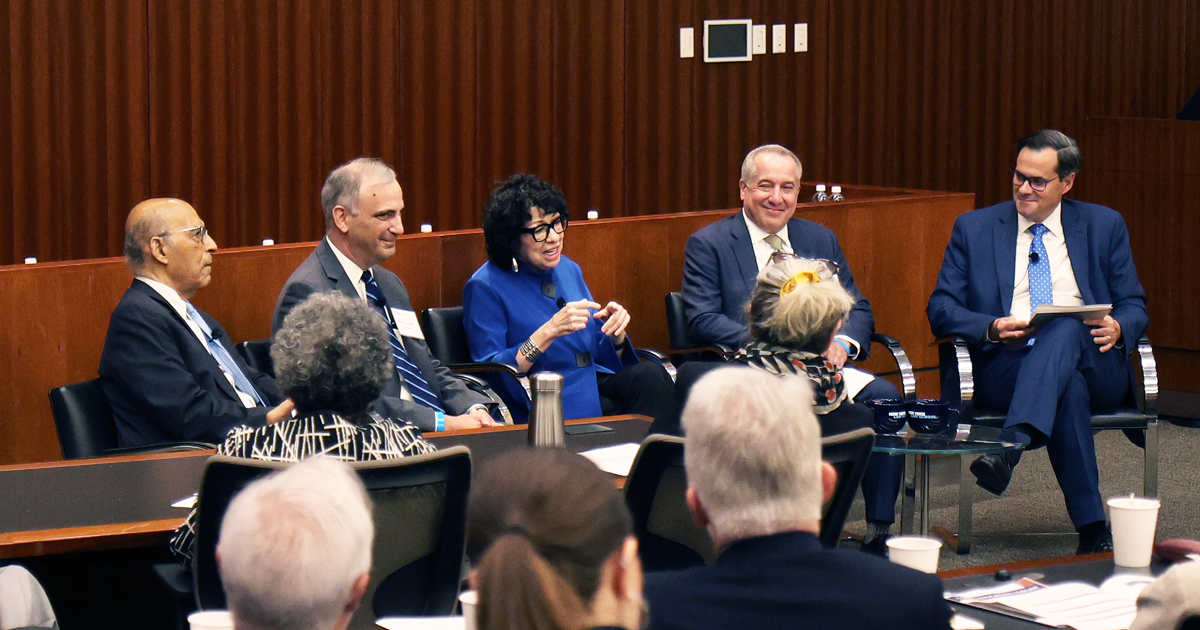
(L to R) Hon. Victor Marrero, Hon. Joseph Bianco, U.S. Supreme Court Justice Sonia Sotomayor, Hon. Anthony Cannataro '96, and Dean Anthony W. Crowell during the Summit's opening session.
Civic Literacy as an Antidote to Misinformation and Disinformation
Panelists: Lara Bergen, Press Pass NYC; DeNora Getachew, DoSomething; Lance Holbert, Leonore Annenberg Institute for Civics; Alan C. Miller, News Literacy Project; Jenna Ryall, New York City Department of Education
Moderator: Grace Rauh, Citizens Union Foundation
The first panel addressed one of today’s most pressing challenges to civic engagement: misinformation and declining public trust in media. Panelists acknowledged how social media and an oversaturated digital landscape may hinder civic engagement, while highlighting how media literacy can empower citizens, especially those in younger generations, to understand their part. Each panelist gave insight into programming within their respective organizations that present solutions to these challenges across schools and communities. Programs highlighted include the NYC Department of Education’s Civics For All initiative, PressPassNYC’s hands-on support for mission-driven student journalists, DoSomething’s creative, youth-focused marketing campaigns, and the Checkology e-learning platform created by the News Literacy Project.
The Inheritance of Civic Responsibility: Building Stewardship Across Generations
Panelists: Hon. Sarah L. Cave, Magistrate Judge, U.S. District Court, Southern District of New York; Jarrell Daniels, Justice Ambassadors Youth Council; Dr. Emma Humphries, iCivics; Linda Johnson, Brooklyn Public Library; Yessica Martinez, Participant of the Justice for All Initiative
Moderator: Hon. Vera M. Scanlon, Chief Magistrate Judge, U.S. District Court, Eastern District of New York
Building on the theme of the opening discussion, the second panel explored the value of civic responsibility across all ages and intergenerational approaches to civics education. Blending the voices of change-making public servants, the session highlighted keynote projects of the Justice for All initiative; models of incorporating resident voices and experiences into policy development and system reform conversations in underserved communities; and accessible learning programs available at the local and national level. Panelists noted how intergenerational civic engagement can promote education and understanding between peers and relatives, and underscored the need to reach underrepresented communities through context-based strategies.
The Legal Profession and Civic Responsibility
Panelists: Brandt Goldstein, New York Law School; Lucy Lang, New York State Inspector General; Hon. Katharine Parker, U.S. District Court, Southern District of New York, and New York City Bar Civics Education Task Force; Randi Furman ’28 Evening, CNN
Moderator: Elizabeth Fine, Liz Fine Advisory
Panel three was introduced by Florence Hutner, Senior Advisor for Academic Affairs at NYLS. Dean of Faculty William P. LaPiana gave a brief opening talk focused on the ways in which lawyers and bar associations have championed civics education since the nation’s founding. Judges, legal educators, and practitioners reflected on how courts, bar associations, and law schools today are implementing programs to educate on several aspects of civics, from the legislative process to voting and jury service. Speaking from their experiences, panelists shared various approaches and techniques for encouraging civic engagement within different segments of the population. Together, they strongly emphasized the value of community, noting how collaborative, unified efforts are necessary for widespread public outreach. This includes developing scalable programming alongside non-legal professionals, such as marketing and communications experts, entertainers, and even artists, to share the mission of how everyday citizens can become more civically engaged.

Alan C. Miller speaking at the Civic Literacy panel.

(L to R) Yessica Martinez, Dr. Emma Humphries, Jarrell Daniels, Linda Johnson, Hon. Sarah L. Cave, and Hon. Vera M. Scanlon during the Inheritance of Civic Responsibility panel.

Rebecca Fanning and NYLS Professor Emerita Camille Broussard at the Simply Civics stand.
Midday “Civics Schmooze” Session
Midday brought a dynamic and experimental series of concurrent demonstrations that Summit participants rotated through. Presenters from the New York Public Library, the New York Historical, the Historical Society of the New York Courts, Empire Arts Film Corp., The Juilliard School, and The Public Theater shared intricately designed programs and initiatives related to civics education and engagement. As partners to legal institutions across New York, the organizations demonstrated how their work brings life to the complexities of American democracy and aids in distilling the essence of the rule of law for all communities. Embodying the pathos of the preceding panel, the “Civics Schmooze” session gave an inside look at how creative and cross-disciplinary methods of teaching civics make an impact.
Capstone Session: Catalyzing the Future: Civics, Learning, and Leadership
The Summit concluded with a forward-looking and interactive capstone session facilitated by Rebecca Fanning of the Administrative Office of the U.S. Courts, Ben Max of NYLS’s Center for New York City and State Law, and Professor Amy Wallace, Director of the NYLS Street Law Clinic. Along with summarizing key insights from the day, facilitators invited participants to contribute perspectives on what they learned and identified intersecting ideas to guide future projects. Drawing from Summit themes and conversations, they synthesized these lessons into items for inclusion in a Blueprint for Action in New York and beyond. Priorities include strengthening civic education through technology, fostering intergenerational learning, expanding collaboration and partnerships, and advancing the civic mission of the legal profession. Indeed, Fanning and Professor Wallace have already begun building on the Summit’s framework to develop toolkits for law schools to partner with federal and state courts and community-based organizations to expand civic learning opportunities.
The 2025 Constitution and Citizenship Day Summit was the launch of a broader civic movement just ahead of the country’s 250th anniversary. NYLS envisions the Summit as a model for replication across the nation, helping law schools, courts, and communities reimagine civic education in the 21st century.
Dean Crowell closed the Summit by noting, “Particularly in conversations about civics, the rule of law, and constitutionalism, we need lawyers to help us understand, interpret, and distill things into their essential form. But it is everyone else who works with lawyers on the ground who helps us create the solution. As we think about a blueprint for civics modernization and public outreach, let’s think about our next steps forward as a large ecosystem of activity and interdependence. It’s the breadth of working together that will create the approaches and solutions that we’ll be able to celebrate for another 250 years.”