

Alumni Spotlight:
Victor Suthammanont ’05
Our Alumni Spotlight Series features some of the most exciting, ambitious, and successful members of our alumni community—NYLS graduates making real differences in New York City and beyond.
In this installment, we reconnected with Victor Suthammanont ’05, whose unique path from the theatre to the courtroom has shaped both his legal practice and his work as a novelist. While his focus includes securities law and commercial litigation, his approach to advocacy remains deeply rooted in narrative.
“It’s a nice marriage of the artistic and the legal.”
Victor Suthammanont ’05 has always been a storyteller. Drawn to art from a young age, he began writing short stories in high school and later earned a B.F.A. in Drama from NYU’s Tisch School of the Arts. Acting, directing, and even doing stand-up comedy, Suthammanont was continually captivated by performance as a form of storytelling. In an unexpected turn, his artistic pursuits led him to the law, and the law, in turn, emboldened his creative passion.
While raising money to produce a screenplay, Suthammanont decided to enroll at NYLS. Almost instantly, he realized just how much of his creative training would come into play during his legal studies. Writing and lawyering, he notes, draw on the same foundational instincts.
“Every scene in a story must serve the main argument or thesis I want to bring forth,” Suthammanont says. “I look at it almost like I’m structuring a legal brief—everything is in service of the primary argument. What ideas or questions do I want to leave the reader with? How is each section serving that? In a novel, I can map out chapter by chapter how each part supports the journey I want to take the reader on. And that feeds back into brief writing: the facts tell one story, the arguments reinforce it, and the structure carries the theme.”
At NYLS, he was inspired by the narrative aspects of law, noting how litigation, in particular, is all about telling a client’s story. He honed his writing skills as an Executive Articles Editor for the New York Law School Law Review and later received the Otto L. Walter Distinguished Writing Award at commencement. Even his acting training converged with the analytical. “The style I studied, Practical Aesthetics, is about putting your attention on the other person and reading the truth of the moment,” Suthammanont explains. “There have been several moments during depositions or investigative testimony when I ask a question, watch the person answer, read their reaction, and follow the thread. It’s a nice marriage of the artistic and the legal.”
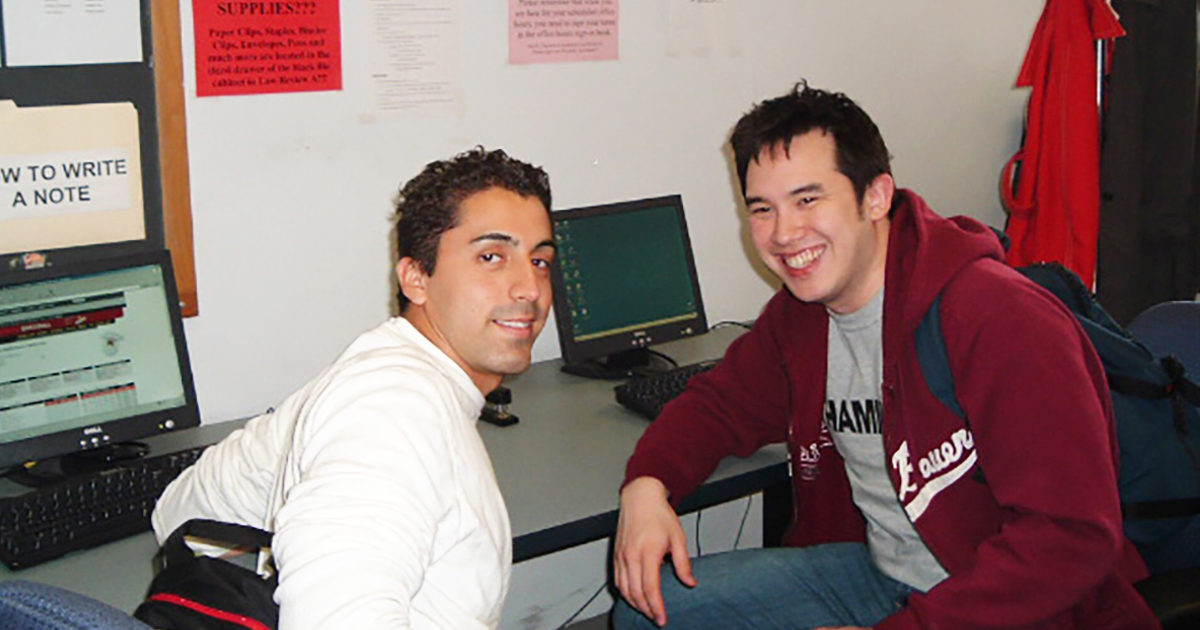
Suthammanont and Andres Munoz ’05 in the NYLS Law Review.
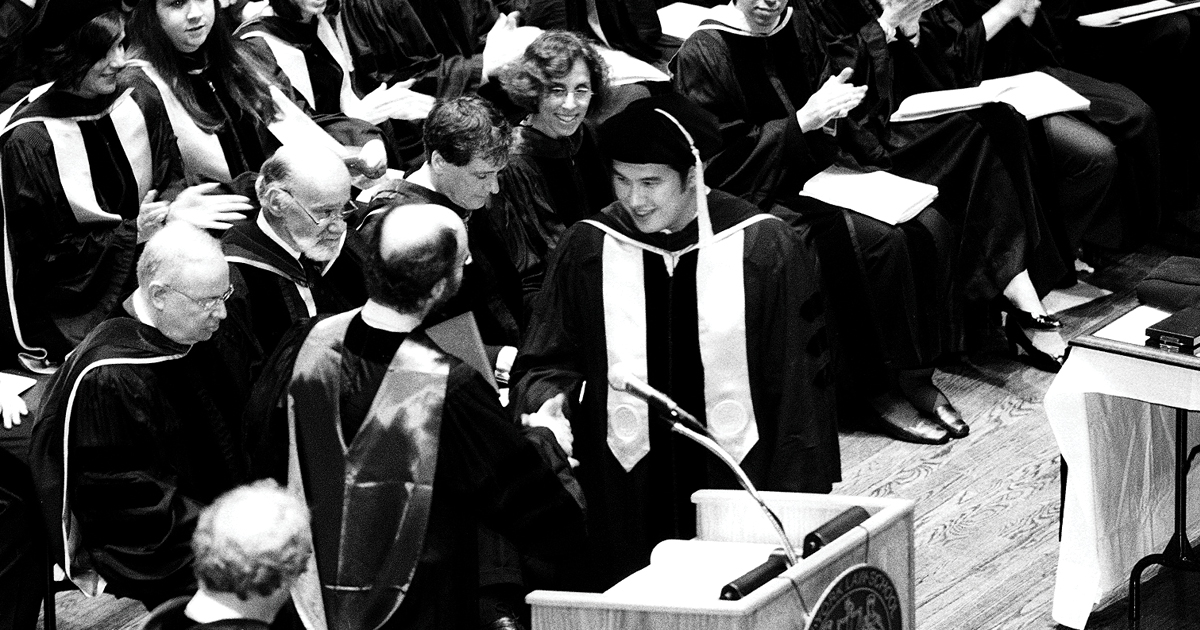
Suthammanont walking the stage at NYLS's 113th Commencement Exercises.
Examining Justice, On and Off the Page
After graduating from law school, Suthammanont clerked for Hon. Maryanne Trump Barry of the U.S. Court of Appeals for the Third Circuit and later joined Cahill Gordon & Reindel LLP, handling complex commercial disputes and enforcement matters. In 2014, he joined the U.S. Securities and Exchange Commission (SEC), where he investigated and litigated securities law violations, including insider trading, market manipulation, and digital asset fraud. His time there, and his legal experience more broadly, influenced his views on justice and uniquely positioned him to assess the system from multiple vantage points.
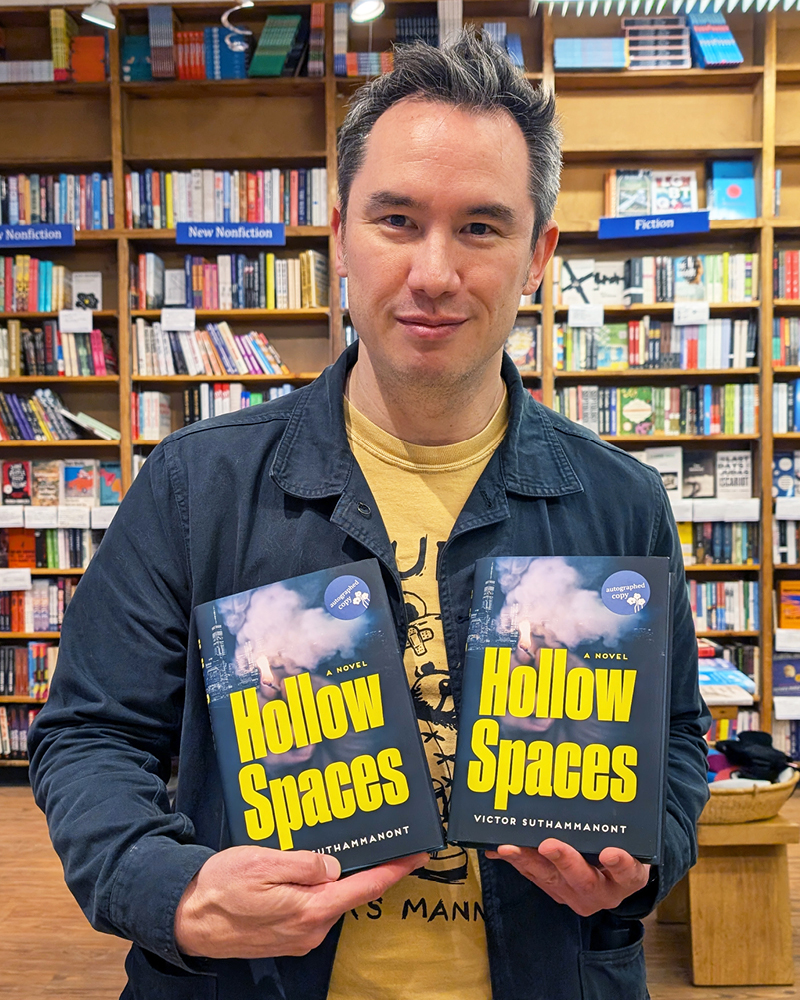
Enter Hollow Spaces, Suthammanont’s debut novel. The New York Times-featured book follows the story of the only Asian American partner at a prestigious law firm whose life implodes after he is tried and acquitted of murder. Three decades later, his adult children reinvestigate the case to uncover the truth.
“I wanted to start a story where most legal dramas end,” Suthammanont explains. “Any practicing lawyer knows that a trial doesn’t always get at the full truth. Verdicts resolve legal elements, not necessarily moral ones. That tension—the gap between the ‘core truth’ and the ‘whole truth’—became central to Hollow Spaces.”
The novel grapples with trauma, family, race, and the limits of courtroom justice, while also dissecting how public opinion can distort truth. In the digital age, Suthammanont notes, the public often forms judgments from limited or oversimplified information. Grabby headlines, for example, can push people to snap conclusions about events that are far more nuanced than they appear, something Hollow Spaces invites readers to examine closely.
“Everything I do is enabled by the community around me.”
Now a partner at Kostelanetz LLP, Suthammanont’s legal practice focuses on securities law, commercial litigation, and white-collar defense. He notes that returning to private practice after a decade in government has been “both harder and easier than expected”—harder due to shifts in the legal landscape, and easier because he feels newly energized by helping clients directly and celebrating the release of his novel.
Suthammanont is also the author of Little Surrenders, an Audible Original short story published in 2020. When asked how he balances his legal career with his creative work, he was quick to highlight the value of community. “I don’t sleep much,” he admits with a laugh. “But everything I do is enabled by the community around me—my wife, my kids, my colleagues.” Read more about Suthammanont’s dual careers in the Fall 2024 NYLS Magazine feature.
Where Law and Literature Meet
To this day, Suthammanont remains vocal about the lasting impact of his NYLS experience. It’s where he met his wife, Arminda Bepko ’04, now a senior attorney at Cleary Gottlieb Steen & Hamilton LLP. He continues to credit Professors Emeriti David Chang and Edward A. Purcell Jr. for shaping his approach to legal analysis, and Professor Ann F. Thomas for instilling the importance of ethics and balance. She, along with Professor Lenni B. Benson and the late Professor Denise C. Morgan, is featured in the acknowledgements of Hollow Spaces.
Speaking to current NYLS students with both legal and creative aspirations, Suthammanont offers practical and philosophical advice: “First and last, we’re human beings. You have to do what fulfills you. If your calling is to be a lawyer and an artist, you can be both—but you have to live with integrity and authenticity.”
He also notes that creative resilience translates directly into legal practice. “In acting school, we were told: you’ll get 99 rejections for every one yes. And learning to handle rejection—something every artist faces—has made me a better lawyer. You don’t win every motion or every case, but you learn to keep going.”
As he looks to the future, Suthammanont hopes to keep bridging the worlds of law and literature. “If I could teach a seminar at NYLS, it would be a ‘Law and Literature’ seminar,” he says. “I think reading and thinking about literature helps us remember how the law serves society, how to stay human as a lawyer, and how to engage with the big questions.”
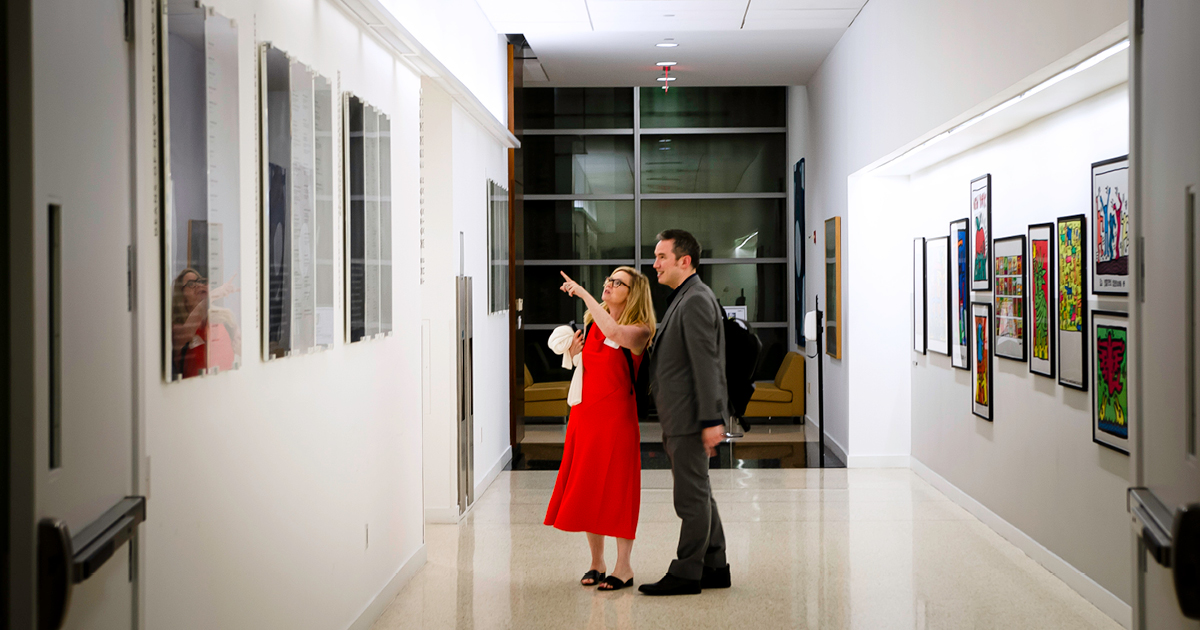
Suthammanont and his wife, Arminda Bepko ’04, at the NYLS launch of Hollow Spaces.
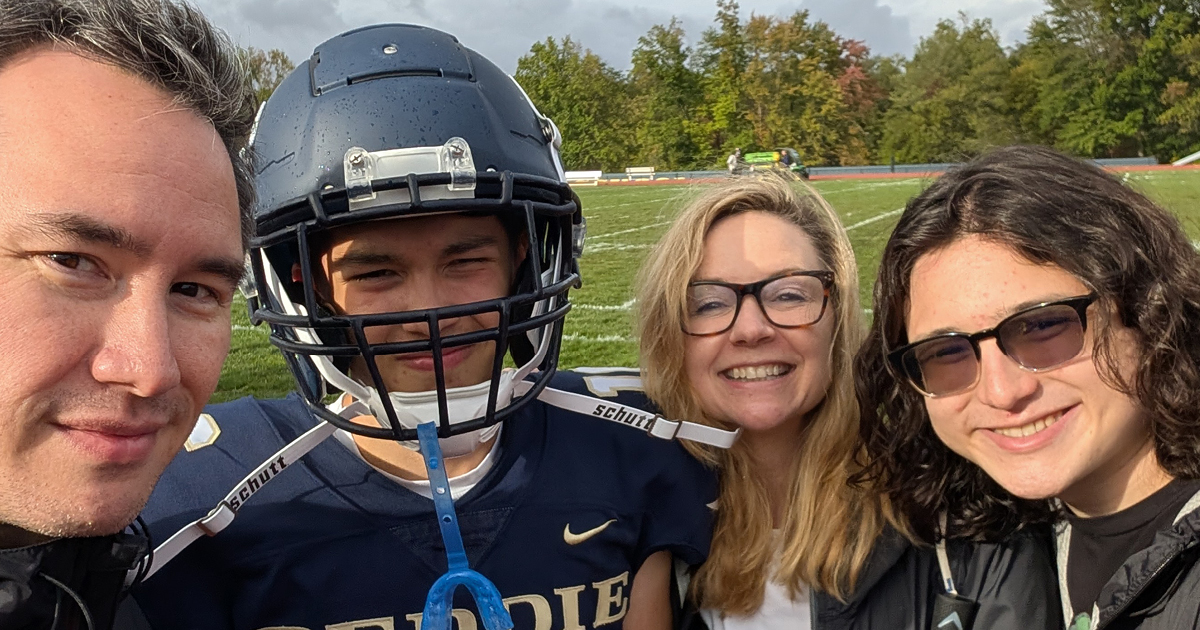
Suthammanont and Bepko with their children.