
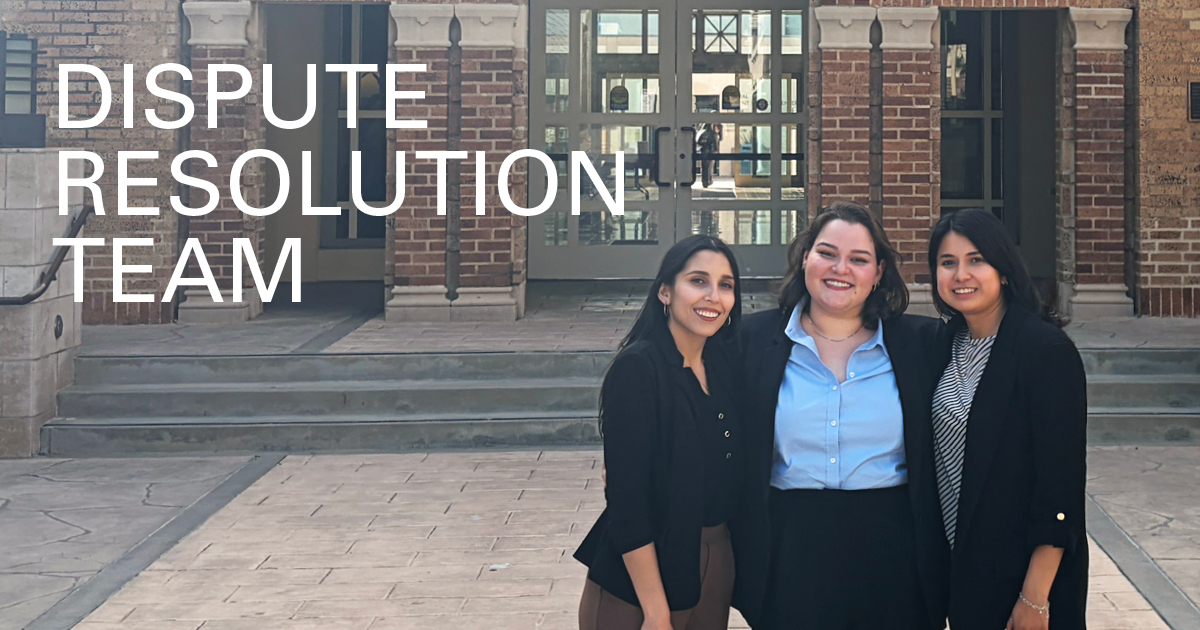
By Sarah Lara ’27, Sam Walsh ’27, and Jacqueline Zamora ’26
The American Bar Association (ABA) Client Representation in Mediation Competitionis one of the largest of its kind, introducing law student participants to the challenges of representing clients in mediation. Each team consists of two students who assume the role of either attorney or client, with judging criteria rewarding an effective combination of advocacy and problem-solving. After two days of competition, the New York Law School (NYLS) Dispute Resolution Team (DRT) earned second place in the nation!

In February 2026, the New York Law School Team, consisting of competitors Sam Walsh ’27, Sarah Lara ’27, and student coaches Jacqueline Zamora ’26 and Jerin Jabin ’26, participated in the regional competition hosted by Regent University School of Law in Virginia Beach, Virginia. They were one of 45 teams competing in early 2026 and vying for a spot in the nationwide competition.Sam Walsh ’27 and Sarah Lara ’27 placed first at regionals, becoming one of only eight teams nationwide to advance to the March 2026 national competition hosted by Chapman University Fowler School of Law in Orange County, California.
The team received the fact patterns two weeks prior to Nationals in preparation for the first two rounds of competition. The facts covered complex areas of law, including a trademark dispute (addressing issues such as mark strength, validity, and reverse confusion involving an economically superior junior user) and claims under the Family and Medical Leave Act (including statutory eligibility, retaliation, interference, and wrongful termination).
Their preparation involved mastering the fact patterns and participating in multiple moot sessions with coaches and fellow DRT members. Over the course of two weeks, Walsh and Lara developed detailed representation plans that outlined each competitor’s role, party interests, best alternative to a negotiated agreement, potential collaborative solutions, key questions for opposing parties, and overall negotiation strategy. They also focused extensively on analyzing relevant law and preparing to navigate emotionally charged or high-pressure moments during mediation.
Walsh and Lara emphasize their appreciation for the support and guidance provided by Professors F. Peter Phillips ’87, Theodore K. Cheng, Shahrokh (Seve) Falati ’08, and Liz Vladeck, all of whom contributed their time and expertise throughout the preparation process.
According to Walsh and Zamora, “Only days before the competition, Professor Cheng reviewed our materials and took the time to share his extensive knowledge of Trademark/IP mediation. We believe this provided the necessary foundation that was influential in our advancement.”
Confident heading into the first day of Nationals, Sarah Lara ’27, Sam Walsh ’27, and Jacqueline Zamora ’26 traveled to California on Thursday afternoon, with competition beginning early Friday morning. After an arduous day of competition, Chapman University hosted a dinner during which the four Semi-Finalist teams were announced.
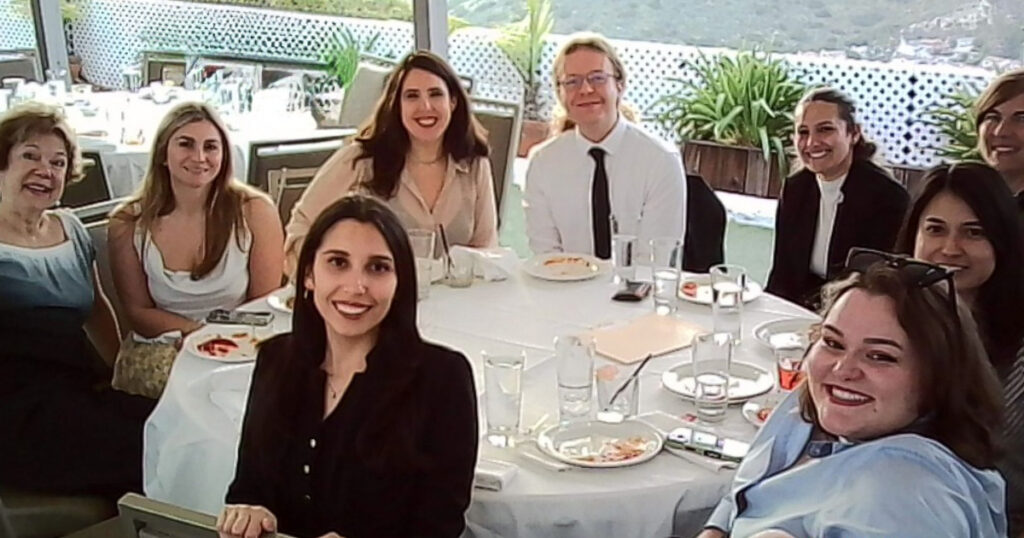
New York Law School was named the fourth seed. Walsh and Lara described hearing their team announced as an unforgettable and exhilarating moment, made even more meaningful upon learning that they were the only student-run team competing at Nationals. They credit their coaches, Jacqueline Zamora ’26 and Jerin Jabin ’26, as instrumental to their success.
Following the announcement, the four advancing teams received confidential materials for both the Semi-Final and Final rounds. With less than 24 hours to prepare, Lara, Walsh, and Zamorareturned to their hotel to begin an intensive night of preparation. The legal issues remained highly complex, with the Semi-Finals involving an employment dispute (covering retaliatory discharge, violations of the False Claims Act, and state equal pay laws) and the Finals focusing on a contract dispute between two large companies (involving indemnity and hold harmless clauses, as well as damages related to past and ongoing litigation).
Despite the tight timeline, the teamdescribes the preparation process as one of the most rewarding aspects of the experience. They worked late into the night reviewing confidential facts and developing strategies that balanced strong client advocacy with collaborative problem-solving. Although physically exhausted, they remained energized by their shared determination and focus.
The following morning was no different. Fueled by caffeine and determination to prove themselves as the fourth seed “underdog,” Walsh and Lara excelled during Semi-Finals. They both used their quick thinking and negotiation skills to produce creative solutions on the spot, addressing what they found to be the other team’s priorities and moving the conversation closer to a settlement.Theyalso honed the skill of adapting to each mediator’s personal style and building rapport, as the Semi-Final round mediator was significantly different than earlier rounds. The mediator used a transformative approach, which focuses on empowering the parties and promoting mutual recognition of each other’s perspectives, aimed at changing the parties’ relationship rather than just resolving the dispute, whereas previous mediators took a more “back seat” approach, allowing the teams to run the mediation themselves. While the change was welcomed, it equally presented the challenge of having to shift their tone, approach, interaction, and goals to match the flow of the mediator.
Immediately after the Semi-Final round, Walsh and Lara learned that they had advanced to the Finals, which David Dowling, the Director of the Straus Institute for Dispute Resolution at Pepperdine University Caruso School of Law, would mediate. The team was grateful for the opportunity to learn from such a skilled mediator.
They ultimately placed second in the competition and received a scholarship offer to the LL.M. in Dispute Resolution program at the Caruso School of Law. This achievement represents not only their dedication but also the strength of the support they received from their coaches, professors, DRT President Anton Freeman ’26, DRT Faculty Advisor Professor F. Peter Phillips ’87, and the entire Dispute Resolution Team.