

The Education Law Clinic at New York Law School works to help create a more equitable, accessible, and just education system in New York City. In this clinic, law students represent public school students who have been arrested or suspended from school and in administrative hearings to secure the special education services they are entitled to under the federal Individuals with Disabilities Education Act (IDEA).
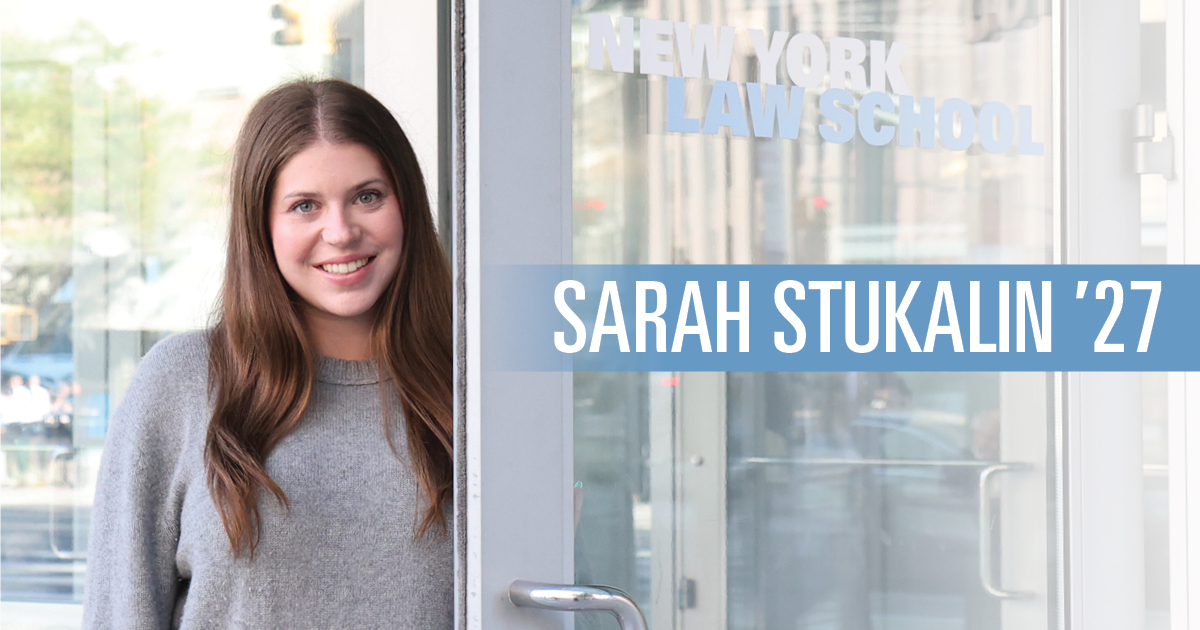
These excerpts capture the reflections of clinic student Sarah Stukalin ’27 on a few of her cases and on her growth as a lawyer-in-training.
Case One: Advocating for a Fighter
One of my clients was multiply disabled and needed one-on-one nursing support accommodations at school. After a semester of preparation, the due process hearing had finally arrived. I had assembled a comprehensive disclosure, drafted a focused and persuasive opening statement, and ensured that my client’s mother was fully informed regarding every detail, so all that remained was to trust that our argument would convince the administrative law judge (ALJ), or hearing officer, to grant my client the accommodations she needed.
In our time before the hearing, I could see the anxiety in my client’s mother: This hearing carried the weight of a decision that could profoundly affect her daughter’s health.
While my supervisor was printing out the New York City Department of Education’s (DOE) disclosure, I had five quiet minutes alone in the conference room with my client’s mother. I could sense how much pressure she was putting on herself. In that moment, it struck me: I knew so much about her daughter’s medical needs and her daily challenges, but I had never actually met her little girl, not even seen a picture.
I mentioned this—that I knew so much about her daughter’s schooling but nothing about who she was outside of that. She immediately brightened. “Well, first and foremost, my daughter is a fighter. She has overcome every odd, and through it all, she remains a happy little girl. She knows how to express her feelings, and when she is experiencing pain or discomfort, she tells me.”
“But,” she continued, “if someone is not there to help her, she will be in pain. She will not be able to breathe, and she likely will not survive. The time between when she has an episode and when she needs oxygen is seconds. Only a trained professional who is with her constantly can keep her safe. For the DOE to take that away from my daughter…” She paused, holding back tears. “It is practically a death sentence.”
We sat in silence for a moment. This was the first time I had seen my client’s mother truly afraid. “Don’t worry about the notes,” I reassured her. “You have been fighting for your daughter since the day she was born. She is alive because of you. You know exactly what to say.”
We won the hearing that day. Sometimes, you witness such an unwavering testament to the human spirit that it becomes clear nothing could ever defeat it.
Case Two: Learning the Language of the Law
In another case, I spoke with a Spanish-speaking parent with limited understanding of English. Though I can communicate in conversational Spanish, I require additional assistance when more complex legal terminology becomes involved. We decided that it would be more effective for the parent to provide written statements in Spanish, allowing her to fully explain the relevant facts in her own words and making the translation process easier for the individual who translated the affidavit.
Following our conversation, I reviewed her daughter’s documents. Among them were an Individualized Education Program (IEP), a due process complaint, several evaluations regarding her child’s needs and abilities, and a 10-day notice alerting the district that their recommended program was inappropriate and that the parent sought funding for a school outside of the DOE that would meet her needs. Nine months ago, I had no idea what any of these documents were or what they meant, so I realized how challenging this process must be for any parent without fluency in this legal “language” I have been learning. That barrier is compounded for non-English speakers. In these moments, the attorney becomes not only a legal advocate but also a translator of a system that can feel confusing and inaccessible.
I recalled a hearing I observed during my summer internship at the Office of Children and Family Services (OCFS) where the respondent’s case did not appear likely to turn out in his favor. What ultimately saved his case was his attorney, who presented a compelling argument, clearly laid out the relevant facts, and effectively advocated on his behalf before the judge. The difference an attorney can make highlights just how high the stakes can be. Experiences like these serve as a reminder that attorneys, the legal system, and the law itself can be incredibly inaccessible to those who must navigate them without guidance.
While my client and I may have differed in the language we speak, the difference goes beyond English and Spanish: I speak the language of the law. In trusting me with her story, this parent entrusted me not only to translate her words, but also to translate an entire legal system. I was honored that my client placed this trust in me.
Case Three: Just Keep Swimming
A client I worked with experiences behavioral challenges. Historically, these difficulties have been largely confined to the classroom. However, I received a call from his grandmother, who informed me of an altercation he had with a teacher. The client’s grandmother raised a number of questions about next steps, many of which I was unable to answer without consulting a supervising attorney. Additionally, some of her concerns fell outside the scope of the assistance we could provide. Although it was a challenging conversation to navigate, I am glad we had it. Moving through this conversation had me thinking about the core principles of lawyering under the New York Rules of Professional Conduct.
Competence
Competence does not always mean having the right answer or being able to resolve every issue a client presents. At times, the most meaningful demonstration of competence is acknowledging when you do not yet have the answer and recognizing the need to seek additional information or consult with a supervisor.
Throughout our conversation, I asked myself, “What would a competent lawyer do in this situation?”Would a competent lawyer recommend a course of action despite uncertainty about its likelihood of success, or is it more appropriate to advise the client that further investigation is needed before providing a well-informed plan? I used the conversation as an opportunity to gently clarify the limitations in my role as a clinic student, while also reassuring her that speaking with me was still a valuable first step, as it allowed me to fully understand the situation and relay it to the supervising attorney so that we could develop a thoughtful plan moving forward.
Difference and Choice
There are undoubtedly different ways I could have navigated this conversation. Even the most experienced attorneys often reflect on client interactions and consider what they might have done differently. Ultimately I faced a choice: Offer guidance without full certainty, risking misadvising the client and compromising my integrity and competence as an aspiring lawyer, or acknowledge that I did not yet have all the answers and take the time to ensure that any advice I provided was well-founded. I recognized that this choice might disappoint the client in the moment, but I also understood that offering inaccurate guidance would ultimately do more harm and complicate her situation.
Societal Context
In reflecting on this interaction, I became aware of the broader societal and cultural structures that shape both my client’s experience and my own role in supporting her. Her age, limited access to the law, and the systemic challenges she faces as a caregiver navigating complex institutions highlight how inequities are embedded in our social and legal frameworks. These structures often place a burden on individuals like her, who are advocating for vulnerable family members without the resources or guidance that more privileged clients might take for granted.
Metacognition
This interaction profoundly shaped my thinking. Rather than responding with anger or frustration, my client thanked me for listening and committed to keeping me updated while I investigated on my end. The experience reinforced that it is not only acceptable, but often necessary, to admit when you do not immediately have the answer and to engage in honest conversations with our clients, even when the truth is not what they want to hear. It may sound simple, but my guiding principle remains: You have to go through the trench, not around it.
Experiential Learning at New York Law School
Experiential learning is an integral part of the NYLS education. Through our top-tier programs, we offer students the opportunity to turn theory into practice: Starting in their first year, students participate in counseling, interviewing, and negotiating exercises in their foundational Legal Practice course. During their upper-level years, students may select from a wide array of experiential learning courses to hone their lawyering skills. Together with a comprehensive legal education, these experiential offerings prepare our students for careers in advocacy.