

“The difference between a good poet and a great poet is that a good poet reads his work and is satisfied.”
– Wallace Stevens, Class of 1903, Pulitzer Prize for Poetry, 1955.
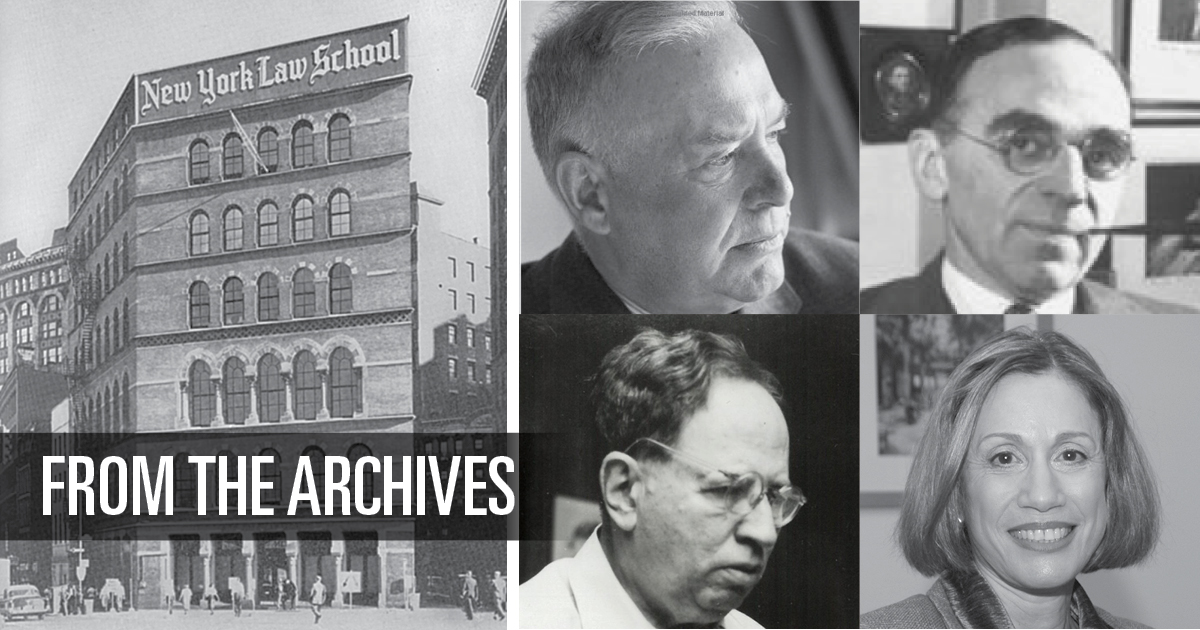
The pursuit of law has a tendency to spark innovation and inspire an appreciation for the written word, so it comes as no surprise that, over the course of New York Law School’s 135-year history, many alumni have engaged in creative industries and projects. Here we honor a few who have made their mark in the literary world as well as law.
Many NYLS graduates have earned widespread recognition in their areas of practice through their writing. The late Judith Bresler ’74, authored Art Law: The Guide for Collectors, Investors, Dealers, and Artists. First published in 1989, Bresler’s treatise on Art Law is known as the “Bible of the industry,” and is widely acknowledged as the cornerstone reference for art professionals. Her treatise continues to guide the field and is now in its Fifth Edition. Bresler served as the Chair of the Art Law Committee of the New York State Bar Association and shared her expertise in Art Law with hundreds of students as a NYLS professor for 25 years.
Morris Ernst, Class of 1912, joined the board of the ACLU in 1927 in his career-long fight against artistic censorship. He successfully defended James Joyce’s 1922 novel Ulysses against obscenity charges in the 1933 case United States v. One Book Called Ulysses, leading to the novel’s eventual publication in the United States in 1934. Ernst co-founded his firm Greenbaum, Wolff & Ernst in 1915, where Alexander Lindey, Class of 1925, later joined him as a long-time partner. In 1932, the two co-wrote Hold Your Tongue!: Adventures in Libel and Slander. Lindey and Ernst penned many other titles, with Lindey publishing his treatise Lindey on Entertainment Law, Publishing, and the Arts, and Ernst authoring more than 35 works throughout his career.
Beyond the legal sphere, the paths of some NYLS students have taken them literally from Broadway to “Broadway.” (At its founding in 1891, NYLS was located at 120 Broadway. It moved into its current home at 185 West Broadway in 2009.) The drama of the courtroom originally lured Henry Denker ’34 to a career in law. But he later left the courtroom and pursued a career as a playwright, bringing several courtroom dramas (including A Case of Libel (1963) and Time Limit! (1956)) to Broadway.
Elmer Rice, Class of 1912, also traded his legal career for that of a playwright. His time as a lawyer inspired plays such as Counsellor at Law, a 1931 drama exploring the ethical dilemmas lawyers faced in their practice. As a playwright, Rice earned many accolades, including a Pulitzer Prize for his 1929 play Street Scene, a realistic tragedy centered around the despair of tenement life in New York City. Rice’s 1923 play The Adding Machine presciently tells the tale of an office worker fearing replacement by a then new technology—an adding machine. A significant work in American theater, the play has been described as a “landmark of American Expressionism.” It recently enjoyed an off-Broadway revival at New York’s Theater at St. Clements.
Other NYLS creatives have penned short stories, novels, and poetry that contribute to the artistic pulse that flows through New York. Arthur Reeve, 1903–1904, created the character Professor Craig Kennedy, who starred as the protagonist in 26 of Reeve’s popular short stories. Professor Kennedy used science to investigate crimes around New York City, serving as an Americanized Sherlock Holmes. He first appeared in Reeve’s 1910 short story The Silent Bullet, which was reprinted, along with the 25 other short stories featuring Professor Kennedy, in the Craig Kennedy Stories.
Ameen Ferris Rihani, 1897–1898, studied at NYLS until a lung infection interrupted his schooling. Born in Lebanon, he returned there in 1905, where he published his work in solitude for six years. Rihani published his somewhat autobiographical novel The Book of Khalid in 1911, during his isolation in the mountains of Lebanon. The novel follows the story of two boys who migrated to the United States through Ellis Island. The Book of Khalid is considered the first Arab-authored English-language novel.
One of the most renowned American poets of the 1900s, Wallace Stevens, Class of 1903, was known for the technical and thematic complexity of his work. The Collected Poems, published in 1954, delves into the link between the world and human imagination and the ways poetry mediates between the two. This collection earned Stevens the 1955 Pulitzer Prize for Poetry.
As we move beyond New York Law School’s first 135 years, we are sure to see additional NYLS graduates turning their talents to the literary world and achieving many future successes.