
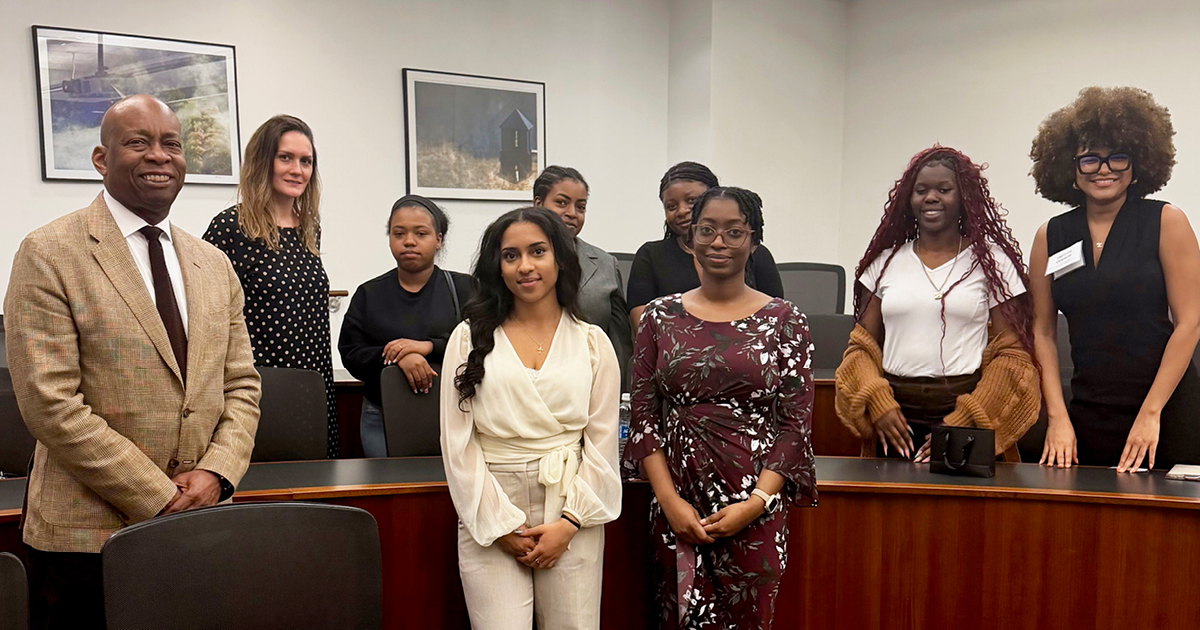
Throughout the Spring 2026 semester, Christina Harris ’26, Vice President for the Day Division of the Black Law Students Association (BLSA), led a series of community-centered initiatives designed to expand access to legal knowledge and create meaningful connections between law students and youth. Through both a structured mentorship program and a returning high school outreach event, these programs focused on demystifying the legal field while encouraging students to see themselves within it.

BLSA x Exalt Mentorship Program
The first initiative, a three-session mentorship program in partnership with Exalt, brought together law students, faculty, and court-involved youth for a series of ninety-minute sessions centered on power, identity, and success. Each session was intentionally designed to build on the last, combining legal education with personal reflection.
The program began on April 4 with a session focused on law school pathways and the concept of power and authority. Harris opened the session by breaking down what law school actually looks like and emphasizing that there is no single path into the profession. What followed was an honest conversation about how legal and academic spaces feel to those who are often underrepresented in them. Students openly shared what felt intimidating, unfamiliar, or inaccessible, creating a foundation for deeper discussion.
From there, the group moved into a power-mapping exercise, where students identified who holds decision-making authority in spaces such as courtrooms, schools, and police interactions, and where they themselves have a voice. This activity allowed students to begin to recognize that power is not always visible but is always present, and that understanding it is the first step to navigating it.
NYLS Adjunct Professor Lydia Payne-Johnson ’96 reinforced these ideas by drawing from her own professional experiences, including her time working on Wall Street. She offered students a real-world perspective on how authority operates in legal and corporate environments, helping bridge the gap between abstract concepts and lived reality. Throughout the session, student engagement remained high, supported by BLSA volunteers Helima Greene ’26, Flavian Phillips ’26, Aicha Conde ’27, Jelani Coleman ’27, and Israel Vargas ’27.
The second session, held on April 11, shifted the focus to identity and the impact of labels. Harris guided students through exercises that asked them to reflect on labels they have been given and whether those labels accurately represent who they are. The conversation quickly evolved into a broader discussion about how labels influence opportunities, perception, and self-concept.
Dean Kirk D. Burkhalter ’04 expanded on this theme by speaking about labels not just as abstract ideas, but as forces that can shape an entire life path. Drawing from his own journey, he shared how his career began as a detective with the NYPD before transitioning into law and ultimately academia. His story demonstrated that identity is not static and that individuals can redefine themselves across different stages of their lives, regardless of how they may have once been perceived.
The session was further deepened by guest speaker Ken Berry, a paralegal who was wrongfully convicted and later exonerated. He spoke candidly about the labels placed on him and the challenges of rebuilding his life after those experiences. His story offered a powerful and personal example of the distinction between a person and their record, reinforcing the session’s central message that identity cannot be reduced to a single moment or label. This session was also supported by BLSA volunteers Helima Greene ’26, Flavian Phillips ’26, Israel Vargas ’27, and Izabella Packer ’27.
The final session, held on April 17, centered on redefining success and encouraging students to take ownership of their futures. Harris guided the students through exercises challenging traditional definitions of success, especially those shaped by institutions such as schools or the justice system. Instead, they were encouraged to define success on their own terms and identify a concrete next step toward achieving it. Dean Burkhalter returned to discuss how systems define success and who benefits from those definitions. The program concluded with a celebration of the students’ participation, including certificates and small gifts to recognize their commitment.
BLSA x George Westinghouse High School
In addition to the Exalt mentorship program, Harris also organized and will lead a returning outreach event at George Westinghouse High School. The initiative was supported by BLSA President Stephanie Pierre-Louis ’26, who also participated in the event. After successfully leading the program last year, BLSA was invited back to continue engaging with minority high school students.
This event focuses on introducing students to the legal field in an accessible and interactive way. Harris will speak about why the law matters, the different pathways into the profession, and why students should consider pursuing it. The program also incorporates hands-on components, including a mock negotiation exercise and a criminal procedure trivia activity, allowing students to actively engage with legal concepts. Dean Burkhalter and Professor Payne-Johnson will join as guest speakers, further reinforcing the program’s emphasis on representation and real-world insight.
Across both initiatives, the goal has remained consistent: to create spaces where students not only learn about the law, but begin to see themselves within it. Through thoughtful programming, honest conversation, and strong mentorship, these events reflect a commitment to making the legal field more accessible, more transparent, and more inclusive for the next generation.