
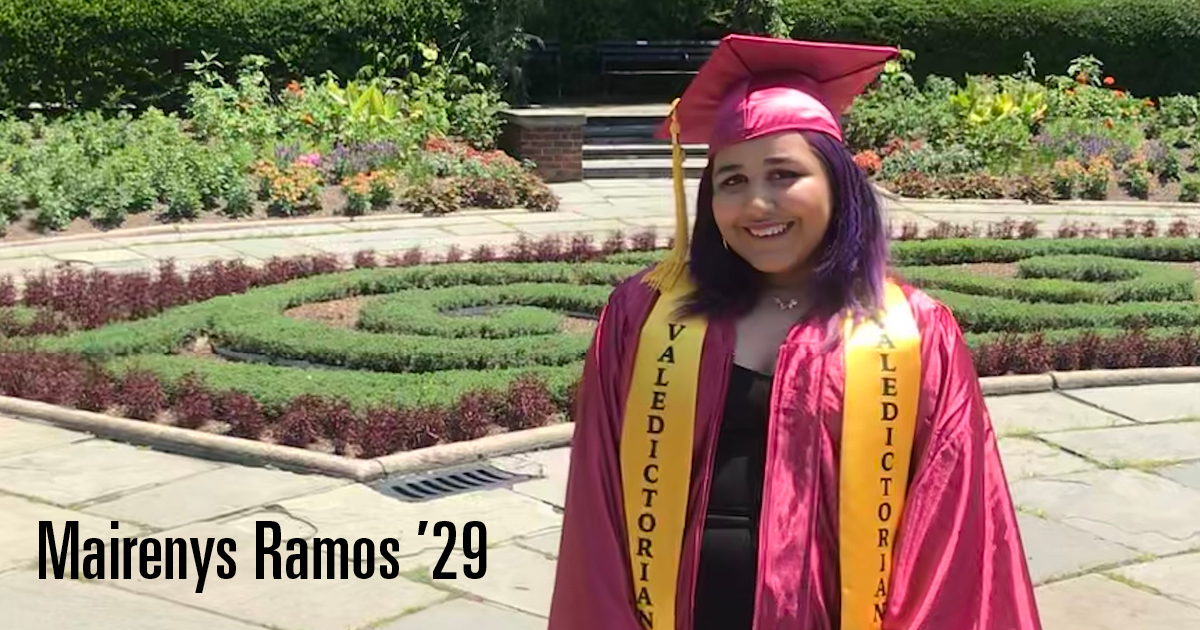

For Mairenys Ramos ’29, the path to New York Law School (NYLS) began long before she ever set foot on campus. Her journey started in middle school, when she joined her school’s debate team and discovered an interest in researching arguments and building cases. That early interest eventually led her to the Charter School for Law and Social Justice (CSLSJ), a high school founded by NYLS Professor Richard D. Marsico, who also directs the Wilf Impact Center for Public Interest Law. Today, Ramos is the first-ever graduate of CSLSJ to attend NYLS, where she hopes to build the skills she needs to serve communities like the one she grew up in.
The history of CSLSJ traces back to the spring of 2009, when Professor Marsico began exploring ways to create greater educational opportunities for students in underserved communities. Three key developments helped inspire the project: 1) a NYLS symposium examining the school-to-prison pipeline; 2) a discussion in Professor Marsico’s Education Law and Policy class about alternative public school models; and 3) thank-you letters from students at a Bronx middle school where NYLS students taught introductory civics lessons. Together, these developments inspired Professor Marsico to envision a different kind of educational pathway that could help students progress from middle school to college and, ultimately, to law school.
What followed was a six-year effort involving NYLS faculty, students, and other community members to research, develop, and secure approval for the high school. Although the team initially considered locating it near NYLS in Tribeca, a community needs assessment led them to the Bronx, where they believed the need for educational opportunities was greater. In partnership with the College of Mount Saint Vincent, the team developed a school centered on law and social justice. CSLSJ welcomed its inaugural ninth-grade class in 2015.
Ramos first learned about the Charter School while exploring her high school options. After learning more about it at a school fair, she applied to transfer, joined as a sophomore, and later graduated as valedictorian of CSLSJ’s second graduating class.
The Charter School’s connection to NYLS provided her with an early introduction to the legal profession. Through the Law School’s Street Law course, taught by Professor Amy Wallace, NYLS students visited CSLSJ to teach lessons on constitutional rights and interactions with law enforcement. Those lessons introduced Ramos to the importance of understanding the law and knowing one’s rights, and the experience stayed with her.
Her perspective was also shaped by growing up and attending school in the Bronx. Comparing her educational experiences with those of friends who attended schools in Manhattan, Ramos became increasingly aware of disparities in school resources and funding. Those observations helped inspire her interest in public interest law and the possibility of using a legal education to help address inequities in her community.
The connection to NYLS resurfaced during her junior year of college, when Ramos began looking for pre-law opportunities. She applied to the School’s Summer Pre-Law Pipeline Program, participating in the summer before her senior year. After completing the program, Ramos applied to NYLS and began her legal education as a member of the Class of 2029.
At NYLS, she has found an environment that reinforces the sense of community she valued in high school. She describes the atmosphere among her classmates as supportive, with students forming study groups and helping one another navigate the demands of law school.
As she explores her interests, Ramos is keeping an open mind about the area of law she ultimately hopes to pursue. Housing law, particularly issues involving evictions and unsafe living conditions, has caught her attention, as has environmental law. One thing she is certain about is her desire to make the legal profession more accessible. As a Dominican woman who grew up in the Bronx, Ramos hopes to bring new perspectives to the field and eventually serve as an attorney who can communicate directly with Spanish-speaking clients without the need for an interpreter.
“I think just making the field more accessible to people,” she says of what she hopes to contribute to the profession. She also hopes to help educate community members about their legal rights, noting that “if there’s a program or workshops of teaching people their rights, I would love to join that. I want to be able to help people in the Bronx, in my community,” she says.
Ramos’ journey from a high school shaped by NYLS initiatives to the law school itself has come full circle. What began as an early exposure to the law has developed into a commitment to using legal education as a tool for service, advocacy, and community impact.