

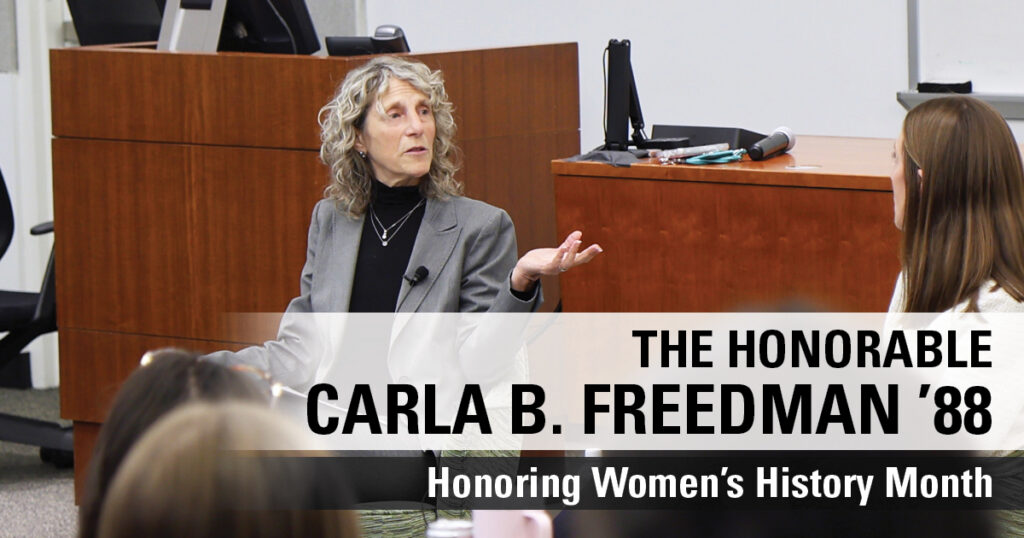
In honor of Women’s History Month, New York Law School (NYLS) is excited to highlight the extraordinary leadership of The Honorable Carla B. Freedman ’88, who recently joined Professor Anna G. Cominsky ’05 for a fireside chat exploring prosecutorial responsibility, ethical leadership, public service, and challenges facing the criminal justice system today. Judge Freedman reflected on a career that has taken her from the Manhattan District Attorney’s Office to the U.S. Attorney’s Office for the Northern District of New York. She now takes the bench as a U.S. Magistrate Judge for the Northern District of New York.
Growing up in Syracuse, Judge Freedman initially dreamed of becoming an actress. While attending Syracuse University, where she majored in political science and immersed herself in student government and the university judicial system, she experienced what she described as a “lightbulb moment.” During an internship at Syracuse Stage, a mentor advised her to pursue acting only if she could imagine being happy performing at the lowest professional level. That advice prompted reflection, ultimately leading her to reshape her ambitions. Drawn to public service and inspired in part by her grandmother, an immigration attorney who argued before the Supreme Court, she entered NYLS determined to become a public defender.
At NYLS, Judge Freedman focused on criminal law, participating in moot court and the Criminal Defense Clinic while interning at the Manhattan DA’s Office to better understand the perspective of the prosecutor. Although her post-graduate plans were set, a final interview with renowned District Attorney Robert Morgenthau skewed her trajectory. During what was expected to be a brief meeting, Morgenthau discussed an unfolding scandal involving transit police officers accused of falsifying arrests. Most striking to Judge Freedman was his commitment to not only prosecuting wrongdoing but also reviewing and potentially dismissing past convictions that may have been tainted.
“That was an ‘aha’ moment,” Judge Freedman recalled, noting how the experience fundamentally transformed her understanding of prosecutorial power and responsibility. When prosecutors truly embody their role as “gatekeepers,” then meaningful justice could begin there, at the earliest stage. She joined the Manhattan DA’s Office, beginning what would become a 16-year tenure handling felony drug cases, organized crime, and complex prosecutions.
Throughout the discussion, Judge Freedman spoke candidly about the realities of prosecutorial discretion—balancing public safety, constitutional protections, mental health issues, addiction, and fairness. While prosecutors must hold individuals accountable, she stressed that ethical decision-making and integrity are essential. Professor Cominsky, a criminal defense attorney, echoed the sentiment. “At the end of the day, our most important job is to be ethical and competent attorneys,” she said. “Justice can’t get lost.”
After relocating back to Syracuse in 2007, Judge Freedman became an Assistant U.S. Attorney in the Northern District of New York, prosecuting large-scale drug trafficking and RICO cases before serving as the office’s Narcotics Chief. In 2021, she was nominated by President Biden and confirmed by the U.S. Senate as U.S. Attorney for the Northern District of New York.
Leading an office that spans 32 counties, four separate areas that comprise Native American tribal lands, and the Canadian border, Judge Freedman approached the role with a focus on leadership and listening. She conducted internal and external “listening tours,” meeting with staff and community stakeholders. Internally, she worked to foster a culture of support and recognition. Externally, she prioritized community engagement and transparency.
Among her key initiatives was launching a pretrial diversion program aimed at addressing mental health and addiction issues before defendants entered the federal prison system. She also strengthened reentry efforts and expanded civil rights enforcement through the office’s Civil Division.
As the conversation turned to the present moment, Judge Freedman addressed concerns about public trust in institutions and the pressures facing the criminal legal system. “Your word matters,” she told students. “When you stand up in court and say you represent the people or the United States, that has to mean something.”
Acknowledging the complexities of today’s political and legal climate, she urged students not to retreat from public service. “This is the time to dig your heels in and do what’s right,” she said. “There are immigrants, homeless individuals, indigent defendants—people who need your voice. Without your dedication and passion, we’ve got nothing.” That message resonates especially strongly as NYLS celebrates its 135th anniversary, reminding us of the Law School’s legacy of public service.
As she takes the bench as a U.S. Magistrate Judge, Judge Freedman’s journey serves as a testament to the power of ethical conviction and steadfast dedication to public service. For NYLS students considering their own paths, her message was sobering but hopeful: the legal system is imperfect and ever-changing, but committed and principled lawyers can shape it for the better.
“You give me hope,” she told students. “We need you.”