


Two of New York Law School’s clinical faculty members, Associate Professor Shahrokh Falati ’08 and Adjunct Professor Erica Braudy, recently presented their work at the 2026 Conference on Clinical Legal Education hosted by the Association of American Law Schools (AALS).
This year’s conference, held in Portland, Oregon, centered around clinical legal education in defense of democracy, recognizing the critical role that law school clinics play in promoting civic engagement and justice across communities. It gathered clinicians from around the country to network, present, and discuss a few subthemes, including the value of law schools in anchoring democracy to uphold and advance norms and integrity. The conference also emphasized pedagogies of resistance and the need to reexamine how clinical education can encourage students to critically examine the law amid new power dynamics.
Professor Falati, the Patent Law Clinic Director and Innovation Center for Law and Technology Co-Director, and Professor Braudy, Housing Rights Clinic Coordinator, Deputy Director of Manhattan Legal Services’ Housing Unit, and Housing Justice Leadership Institute Program Manager, were among this year’s participants selected to present posters featuring their work.
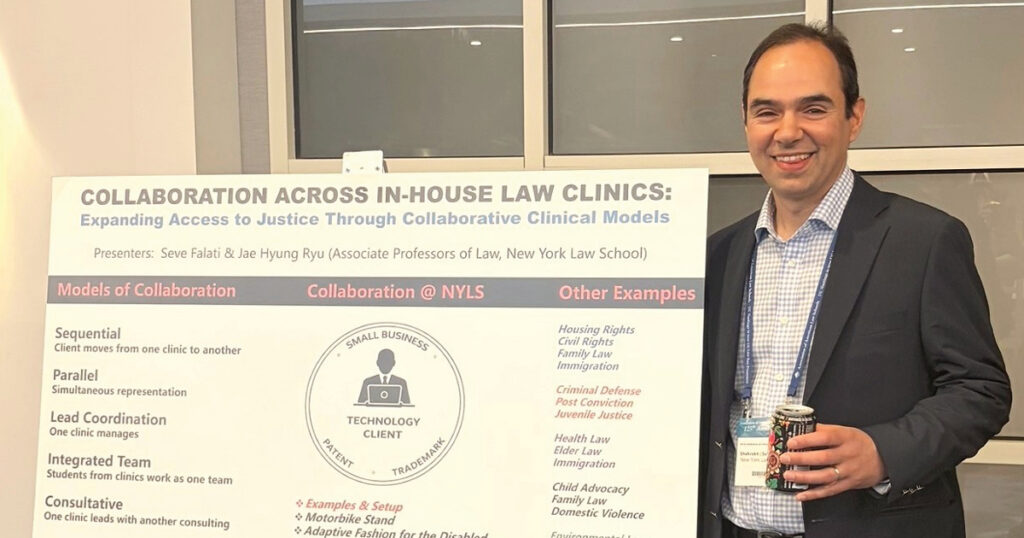
Professor Falati focused on collaboration among in-house clinics. Together with their students, Professor Falati and Associate Professor Jae Hyung Ryu, Director of the Nonprofit and Small Business Clinic, worked to support small technology companies’ client goals across patent and business formation and development as they moved from one clinic to the other with simultaneous representation. The presentation provided case studies of their joint work and sought to illustrate the many benefits for all stakeholders involved: clients, students, and faculty throughout the process of addressing diverse legal needs. For instance, collaborating students appreciate the multidimensional nature of legal work and how collaboration in practice is an essential lawyering skill. Meanwhile, select clients enjoy the benefits of a one-stop shop for many of their legal needs, and faculty who jointly train students share their expertise and teaching methodologies.
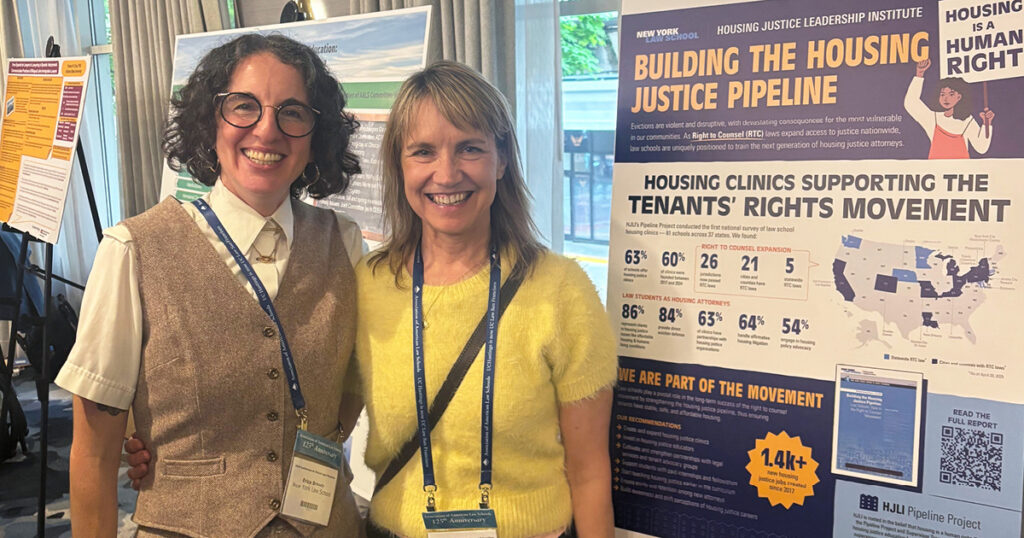
Professor Braudy’s presentation focused on harnessing the strength of housing clinics to build the housing justice pipeline. This is a key component of the Housing Justice Leadership Institute (HJLI), which was launched in 2017 alongside the nation’s first Right to Counsel law for tenants. HJLI supports housing justice education to ensure students have the skills and training necessary to fight the violence of evictions and take advantage of the surge in jobs created by the Right to Counsel movement. HJLI’s Pipeline Project and Supervisor Training help develop and train housing justice attorneys. The project recognizes the importance of law schools in ensuring the long-term success of the Right to Counsel Movement. Moreover, the Pipeline Project conducted the first national survey among 81 law schools and found that the majority of schools have housing justice clinics, with most being founded after 2017 (when the Right to Counsel Law was passed). Professor Braudy’s work illustrates not only the need for housing clinics, but also the value in investing in future housing justice practitioners as a means to further the tenants’ rights movement and housing justice nationally.
Both professors had excellent experiences and enjoyed the opportunity to share ideas and take home new ones on clinical pedagogy and best practices.
Learn more about Professor Falati and Professor Braudy’s work and NYLS’s clinical legal education offerings:
- “National Study Reports Progress on Law Schools’ Central Role in Safeguarding Housing and Community Stability” (Fall 2025)
- Clinics and Experiential Learning
- Housing Justice Leadership Institute
- News From NYLS’s Patent Law Clinic
Experiential Learning at New York Law School
Experiential learning is an integral part of the NYLS education. Through our top-tier programs, we offer students the opportunity to turn theory into practice: Starting in their first year, students participate in counseling, interviewing, and negotiating exercises in their foundational Legal Practice course. During their upper-level years, students may select from a wide array of experiential learning courses to hone their lawyering skills. Together with a comprehensive legal education, these experiential offerings prepare our students for careers in advocacy.