
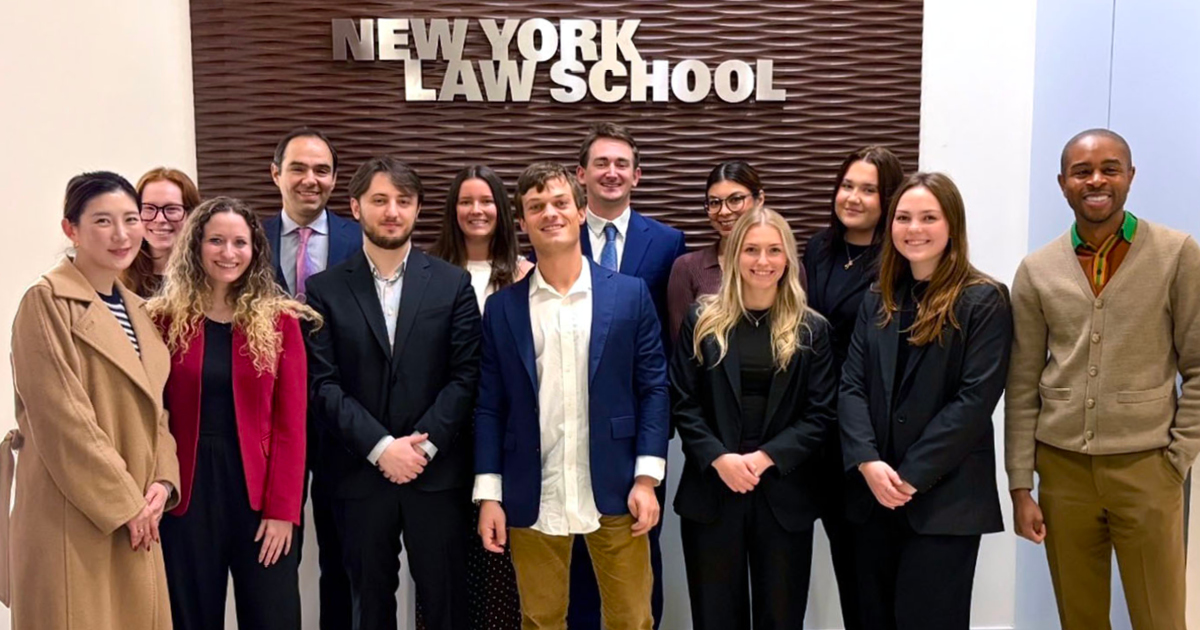
(From left to right) Sarah Lim ’27, Corinne Gumpman ’27, Julia Wert ’27, Professor Seve Falati ’08, Yianni Papageorgiou ’27, Natalie Dworek ’27, Duncan Jurkowitz ’27, Christopher Ducey ’27, Aleena Raza ’27, Julia Buckley ’27, Gabriela Ledwon ’27, Lauren Behrens ’27, and Clifford Bowens ’27.
The Patent Law Clinic (PLC) of The Plumeri Center for Small Business Empowerment at New York Law School (NYLS) has successfully secured U.S. patent protection for an innovative robotic beverage service system designed to enhance efficiency within the hospitality industry.
This now patented technology was created by inventor Gregory Finkelson in collaboration with Maria Concetto Winery, a woman-owned winery and tasting room founded by Maria Reznikova in Calistoga, Napa Valley, California.
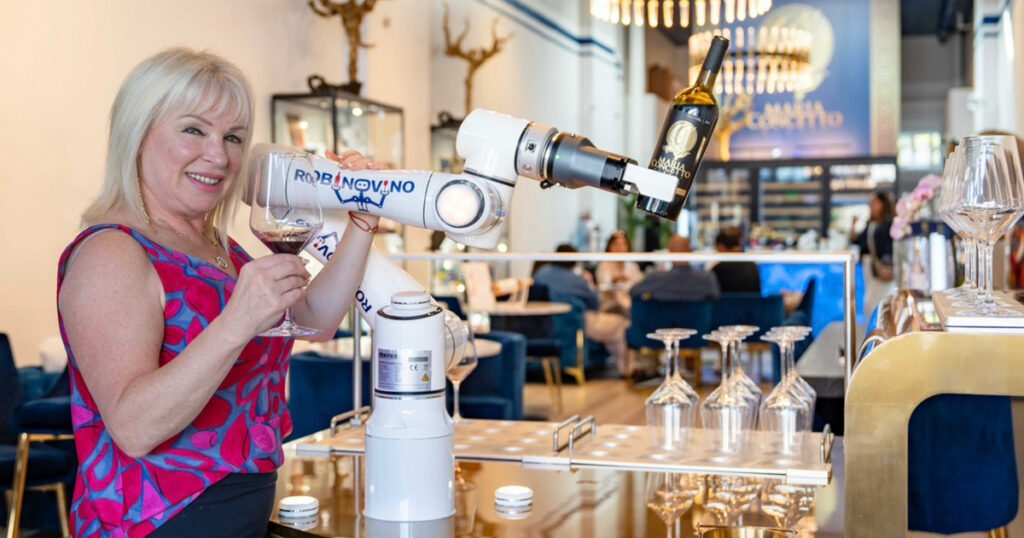
Developed with the assistance of law student clinicians at NYLS under the supervision of Professor Shahrokh (Seve) Falati ’08 , the invention integrates robotic movement, sensor technology, and computer software into a beverage service platform. Unlike traditional automated dispensers that simply pour beverages, the now patented system autonomously performs a series of coordinated functions. Once a customer stands at the bar, using sensors and computer software, the system automatically retrieves a clean glass, places it on the counter, pours a precisely measured beverage of choice, returns bottles to their storage area, and prepares for the next order.
The inventor also incorporated gesture recognition technology, allowing the system to recognize certain customer hand movements that may indicate a request for another beverage, creating a more natural interaction between customers and the robotic system. In addition to its functional capabilities, the robot can perform entertaining, dance-like movements to enhance the customer experience.
This new technology offers several potential benefits for businesses operating in the hospitality industry. Establishments such as wineries, restaurants, hotels, cruise ships, sports arenas, and large entertainment venues often experience periods of exceptionally high demand. By automating repetitive tasks, the system can increase beverage service speed, improve consistency, reduce spills, minimize product waste through precise pours, and strengthen inventory control. In conjunction, employees can continue to play an essential role by welcoming guests, providing recommendations, answering questions, and providing the personal interaction that no machine can replace. This invention reflects a broader trend toward collaborative human-robot environments in which technology enhances both the performance and the customer experience.
Beyond its immediate commercial applications, this invention illustrates the expanding role of artificial intelligence and robotics in modern service industries. As intelligent automation in society evolves, technologies such as this robotic beverage service system demonstrate how machines can assume repetitive physical tasks while employees can focus on tasks requiring interpersonal skills.
The path to securing patent protection was technically and legally demanding. During examination before the U.S. Patent and Trademark Office, the application encountered multiple substantive rejections that required analysis of the cited prior art, strategic claim amendments, and persuasive advocacy to distinguish the invention from existing technologies. Following this extensive prosecution, the PLC successfully secured allowance of the application, resulting in the issuance of the patent.
This work was accomplished through the collaborative efforts of PLC students Lauren Behrens ’27, Natalie Dworek ’27, Duncan Jurkowitz ’27, and Yianni Papageorgiou ’27, working with Professor Falati to secure Mr. Finkelson’s patent.
As a kind gesture, the inventor of this technology sent an open invitation to members of the Patent Law Clinic to visit the winery for a complimentary wine tasting featuring RobinoVino®, the winery’s now patented and operational robotic wine server.
Patent Law Clinic Client, Gregory Finkelson
“Working with Professor Seve Falati and the NYLS Patent Law Clinic has been an exceptional experience. The patent process was long and at times challenging, but Professor Falati and his students never gave up. Their professionalism, persistence, and dedication ultimately helped bring our RobinoVino® invention to an issued patent. Seeing RobinoVino® operating today at Maria Concetto Winery and entertaining our guests makes this achievement especially meaningful. I am sincerely grateful to Professor Falati and the entire Patent Law Clinic team at New York Law School for helping turn an innovative idea into protected intellectual property—and I look forward to welcoming them to Calistoga so RobinoVino® can personally pour them a well-deserved glass of wine!”
Patent Law Clinic Student, Duncan Jurkowitz ’27
Working on the robotic beverage dispenser patent was one of the most valuable experiences I had in the Patent Law Clinic. The invention presented a challenging patentability analysis, and the process of researching the prior art and determining how to distinguish the invention gave me a much better understanding of how patent prosecution works in practice. I particularly enjoyed working directly with the client and learning how to take a complex technical invention, understand what made it unique, and translate those features into a legal strategy. The experience gave me an opportunity to apply what I had learned in the classroom to a real client matter and showed me how much judgment and creativity can be involved in patent prosecution.
Patent Law Clinic Student, Lauren Behrens ’27
We were initially uncertain how to move forward with prosecution. After discussing the application among the student team, with the client, and with Professor Falati, we were able to amend the claims to more precisely define the scope of the invention. We also faced significant challenges in distinguishing the invention from the prior art references cited by the USPTO. Through our discussions with Professor Falati, we were able to reframe our argument and articulate why, even when considered in combination, the cited prior art references did not render our client’s invention obvious. Working closely with the client and the entire clinic was a great experience, and I was able to learn so much from them. Having this patent allowed was an incredibly rewarding experience and is certainly one I will carry with me throughout my career.
Experiential Learning at New York Law School
Experiential learning is an integral part of the NYLS education. Through our top-tier programs, we offer students the opportunity to turn theory into practice: Starting in their first year, students participate in counseling, interviewing, and negotiating exercises in their foundational Legal Practice course. During their upper-level years, students may select from a wide array of experiential learning courses to hone their lawyering skills. Together with a comprehensive legal education, these experiential offerings prepare our students for careers in advocacy.